
About Web 3.0
Summary
Web 3.0 is the next wave of internet in which people operate on decentralized, quasi-anonymous platforms.
Why web 3.0?
- Solves problems of web 2.0, such as centralization with a few large companies controlling the majority of data.
- Greater privacy and control over one's own data
- Third party intermediaries become less important - things are more direct
- More control over digital assets and identities
Evolution of the Internet Towards Web 3.0
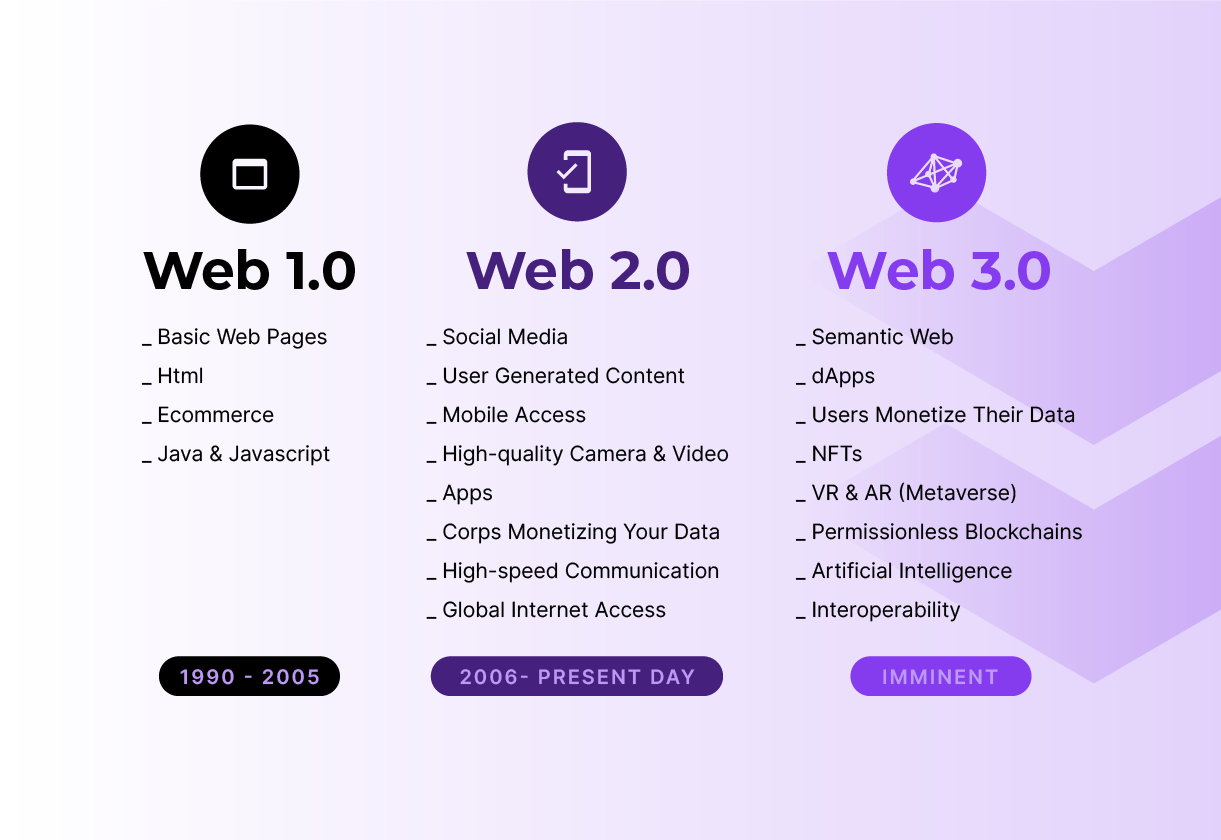
Here are some basic differences between web 1.0, 2.0, and 3.0:
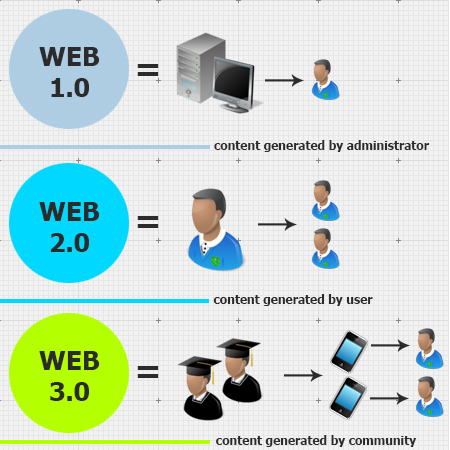
The approach to content sharing is a major change for web 3.0. In web 1.0, content was generated by a computer admin, making the quantity and diversity of content very limited.
Then, in web 2.0, websites began to enable users to generate content. The user-generation trend exploded, allowing users with little to no computing skills to share images, videos, gifs, text, audio, and all sorts of content. Companies like Facebook and YouTube were born in this era.
As we start to enter web 3.0, content will not be uploaded and downloaded from a central location, but instead shared via peer to peer networks. With this comes new forms of digital ownership where content doesn't belong to the companies that store it, but to the users who create it.
Sources
- Image 1 (Comparison of web 1.0 vs 2.0 vs 3.0) - Elastos.io ("What Is Web 3.0? The Fundamental Guide To The New Era Of Digital Data Ownership" 2022)
- Image 2 (Comparison of web 1.0 vs 2.0 vs 3.0 content sharing) - Affinity VR ("What the Web 3.0 exactly is?"", 2019)
- "People are talking about Web3. Is it the Internet of the future or just a buzzword?" - NPR, 2021
- "What Is Web 3.0 & Why It Matters" - Fabric Ventures, 2019
- What is Web 3.0? – A Detailed Guide to the Next Generation of the Internet - Crypto Academy, 2022