| History of SAN |
| Email President McCormick at rlm@u.washington.edu and the Board of Regents at regents@u.washington.edu to show your support and demand recognition NOW. |
Strike for Union Recognition Begins December 4 2000
Below is information about GSEAC/UAW compiled by Undergraduates United in Support of GSEAC/UAW; at the end is the GSEAC/UAW press release announcing the strike, including a fact sheet.
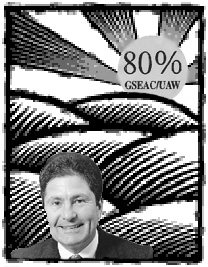 Wake up, President
McCormick!
Wake up, President
McCormick!
The
alarm is ringing--you're late for Democracy 101. Like 68% of lower-level
undergraduate courses, this class is taught by an overworked, underpaid
Teaching Assistant without a union contract. We are counting on you to
recognize GSEAC/UAW and end the strike!
What is GSEAC/UAW?
The Graduate Student Employee Action Committee/United Auto Workers
(GSEAC/UAW) represents all the teaching assistants, readers, graders and
tutors at the UW (including some undergraduates). During Spring Quarter,
84% of TAs, readers, graders and tutors signed union cards authorizing
GSEAC/UAW to negotiate on their behalf. Now, 86% of voting
GSEAC/UAW members have authorized a strike unless President McCormick
recognizes the union and begins collective bargaining. Contrary to
the administration's statement, enabling legislation is not
necessary for McCormick to recognize GSEAC/UAW. Under the
existing legal framework the administration can voluntarily recognize
and begin bargaining with GSEAC/UAW. Since the
administration has refused to
recognize the union, GSEAC/UAW will go on strike Monday December 4.
Why did GSEAC/UAW form?
GSEAC/UAW formed because academic student employees are demanding
their
right to collective bargaining. Collective bargaining allows them to
negotiate as equals and establish binding contracts covering wages,
benefits, and working conditions. Graduate student employee unions have
been recognized at 28 other universities, including the University of
Oregon and the entire University of California system. It is time for the
UW administration to join its peer institutions and recognize the union.
How does GSEAC/UAW benefit undergraduates?
TAs work hard for us. On top of their own rigorous coursework, they
teach
our classes, head our labs, lead our sections, read our papers, and grade
our tests, as well as hold office hours and advise individual
students. Without a union contract, TAs are subject to the whim of an
administration that cares more about its own power than it does about the
quality of our education. GSEAC/UAW will ensure a fair, stable teaching
environment for TAs, which means a fair, stable learning environment for
us.
Join Undergraduates United in Support of GSEAC/UAW. Demand that President
McCormick recognize the union!
Some undergraduate student groups supporting GSEAC/UAW:
ASUW
Affordable Tuition
Now!
Campus Radical Women
Democracy and
Globalization Working Group
Movimiento
Estudiantil Chicano de Aztlán
Nader for President Campaign - UW
Ruckus
Socialist Alternative
Student Action Network
Students for Economic Democracy
Washington Students Against Sweatshops
Other campus groups that have publicly
announced support for GSEAC/UAW:
Graduate and Professional
Student
Senate
Faculty Senate
To meet the needs of undergraduates, most TAs work well beyond 19.5 hours a week. Salaries have not kept up with the cost of living in Seattle, and last year the administration cut TA health benefits by 40%. As undergrads, many of us will be TAs in the near future, and all of us will be workers. Our solidarity with GSEAC/UAW not only supports their rights, it supports our own educational environment and our future. Tell McCormick to recognize the union and end the strike! Contact him at rlm@u.washington.edu or 206-543-5010.
GSEAC/UAW
4500 9th Avenue NE, Suite 300
Seattle, WA 98105
206-633-6080
For Immediate Release: Tuesday, November 28, 2000
GSEAC/UAW CALLS STRIKE FOR DECEMBER 4TH AT THE UNIVERSITY OF WASHINGTON
The Graduate Student Employee Action Coalition/United Auto Workers (GSEAC/UAW), the Union representing 1600 Teaching Assistants, Readers, and Tutors at UW, has called for a strike to begin if the University continues to refuse to recognize the Union.
In a vote held October 31- November 3, members of GSEAC/UAW voted 984 to 164, an 86% majority, to authorize a strike if the UW administration does not recognize and bargain with the Union. The UW administration has consistently refused to recognize the Union despite the fact that over 80% of UW's Teaching Assistants, Readers, and Tutors have repeatedly chosen GSEAC/UAW as their collective bargaining representative.
"It's time for President McCormick to recognize the choice we have made," said Kimberly Hoover, a Teaching Assistant in School of Social Work and member of GSEAC/UAW. "The majority of Teaching Assistants, Readers, and Tutors has chosen GSEAC/UAW and we're ready to strike."
"TAs, Readers, and Tutors are critical to providing the quality education that makes UW a great public university," said Jasmin Weaver, an undergraduate at UW and President of the Associated Students of the University of Washington (ASUW). "Hopefully President McCormick will recognize GSEAC/UAW and avoid unnecessary disruption of our education."
Academic student employees at 28 campuses in many states across the country -including California, Oregon, Michigan, Wisconsin, and Massachusetts - have formed unions and bargained contracts with their employers.
The National Labor Relations Board (NLRB) recently extended collective bargaining rights to Academic Student Employees at New York University, a ruling that will establish precedent for hundreds of thousands of academic student employees at private institutions across the country. The NLRB decision reads in part "... we will not deprive workers who are compensated by, and under the control of, a statutory employer of their fundamental statutory rights to organize and bargain with their employer, simply because they are also students."
"On behalf of 150,000 union members in King County, I am very
disappointed that the University of Washington is refusing to recognize
GSEAC/UAW," said Steve Williamson, Executive Secretary of the King County
Labor Council. "We stand in solidarity with these workers, and will do
everything in our power to make their strike as effective and successful
as possible."
FACT SHEET ON GSEAC/UAW AT THE UNIVERSITY OF WASHINGTON
Who We Are
The Graduate Student Employee Action Coalition/United Auto Workers
(GSEAC/UAW) is the Union for the 1600 Teaching Assistants,
Readers/Graders, and Tutors at the University of Washington. With
responsibility for approximately half of UW's undergraduate education, we
play a crucial role in UW's educational mission.
Huge Majority of Academic Student Employees (ASEs) Join
GSEAC/UAW
An overwhelming and growing majority of ASEs at UW have chosen
GSEAC/UAW to represent us in collective bargaining with the UW
administration. Over 80% of us employed during Winter Quarter 2000 signed
GSEAC/UAW authorization cards, while 84% of us employed in the Spring did
so. In the Spring, 92% of card signers took the additional step of
signing onto a public statement insisting that UW respect our choice for
collective bargaining and recognize our Union.
UW Administration Refuses to Voluntarily Recognize GSEAC/UAW
Despite the huge and growing mandate for collective bargaining among
ASEs on campus, the UW administration has refused to work under the
existing legal framework that enables them to voluntarily recognize and
begin bargaining with GSEAC/UAW. Under current Washington State law, the
UW administration remains free to voluntarily recognize our Union.
UW Lagging Behind
In choosing collective bargaining through GSEAC/UAW, ASEs at UW join
a growing national movement. Public universities in many other states
(California, Oregon, Michigan, Wisconsin, Massachusetts, New York,
Florida, Iowa, Kansas, etc.) have recognized ASEs' collective bargaining
rights. ASEs on 28 public university campuses in the US - as well as 20
in Canada - are organized in Unions and bargain collectively with
their employers.
In addition, the National Labor Relations Board (NLRB) recently extended collective bargaining rights to Academic Student Employees at New York University, a ruling that will establish precedent for hundreds of thousands of academic student employees at private institutions across the country. The NLRB decision reads in part "... we will not deprive workers who are compensated by, and under the control of, a statutory employer of their fundamental statutory rights to organize and bargain with their employer, simply because they are also students."