0 2025/comparch computer architecture
Computer Architecture Gallery
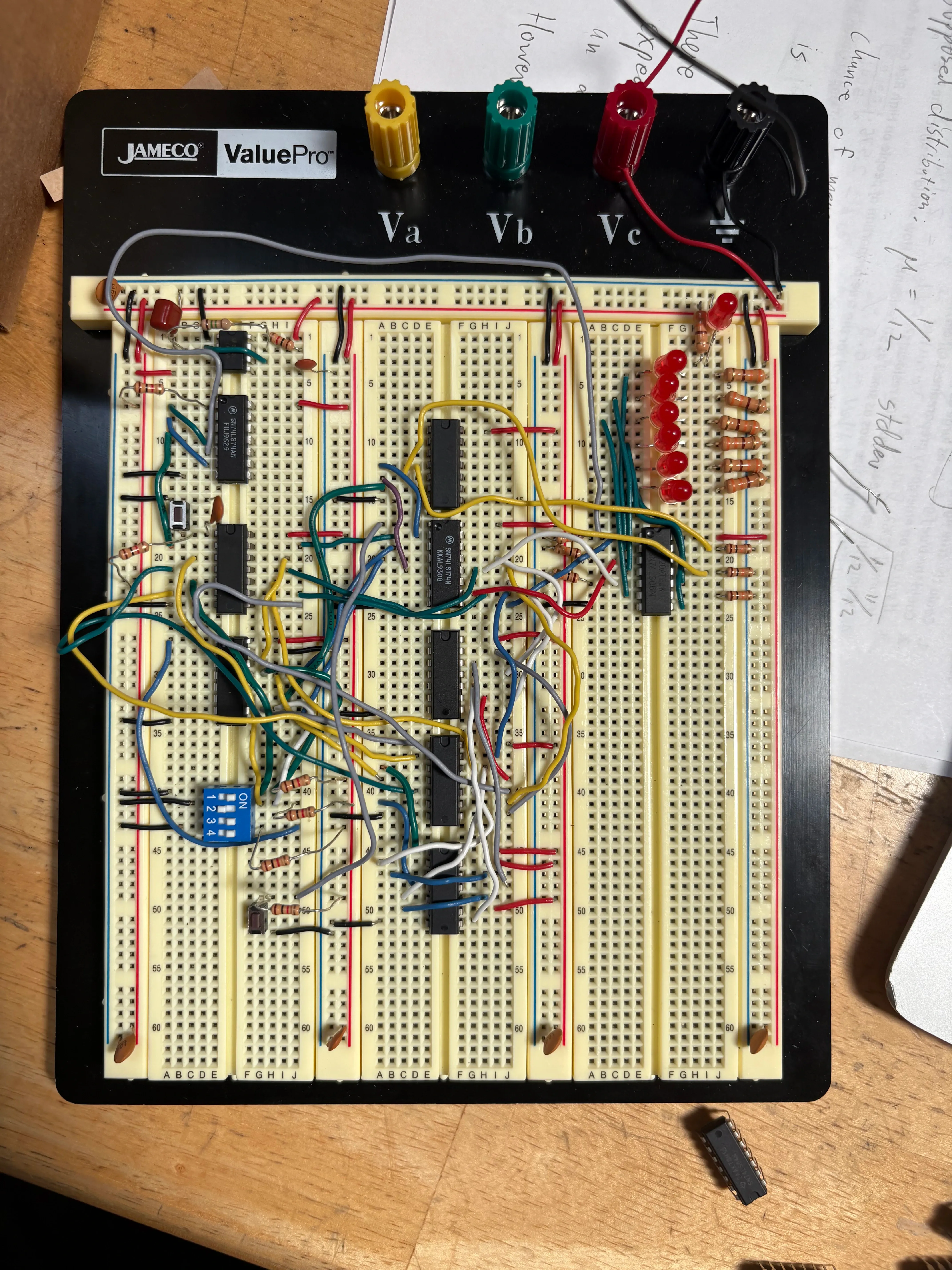
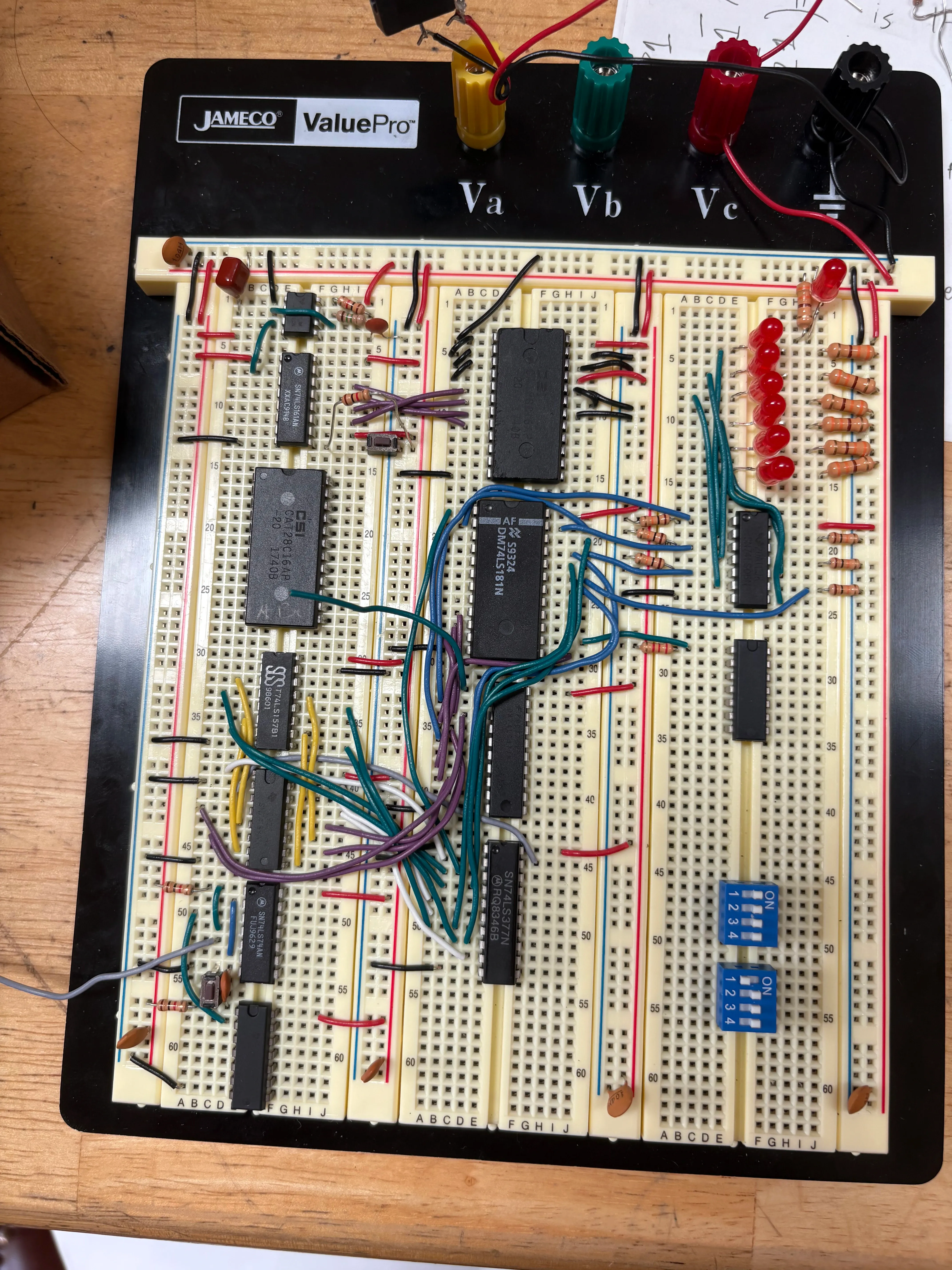
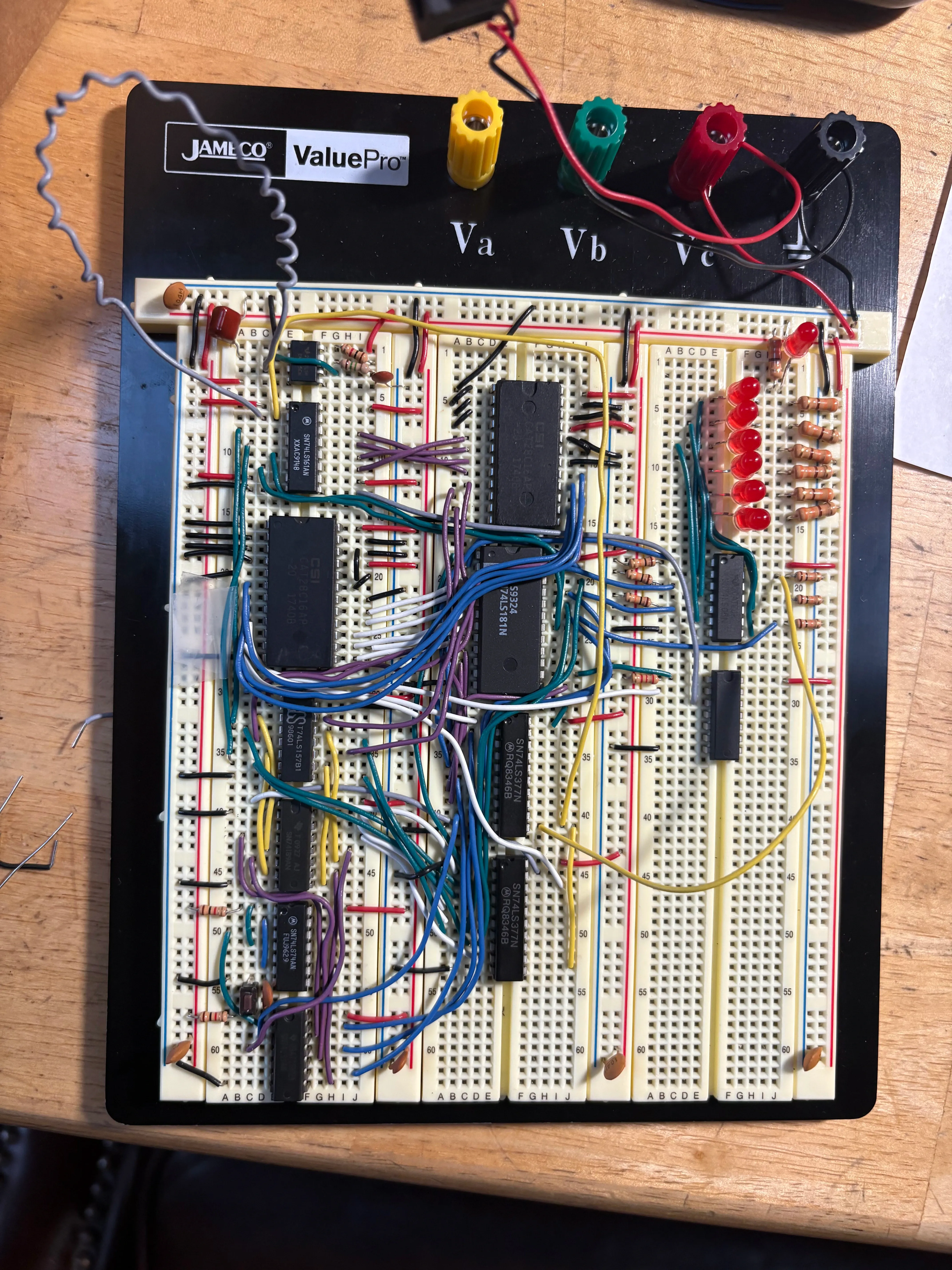
4-bit breadboard computer based on the following paper:
- Feinberg, D. (2007). A simple and affordable TTL processor for the classroom. Computer Science Education, 17(2), 107–116. https://doi.org/10.1080/08993400601165412
| Stage 1 | Stage 2 | Done! |
|---|---|---|
 |  |  |
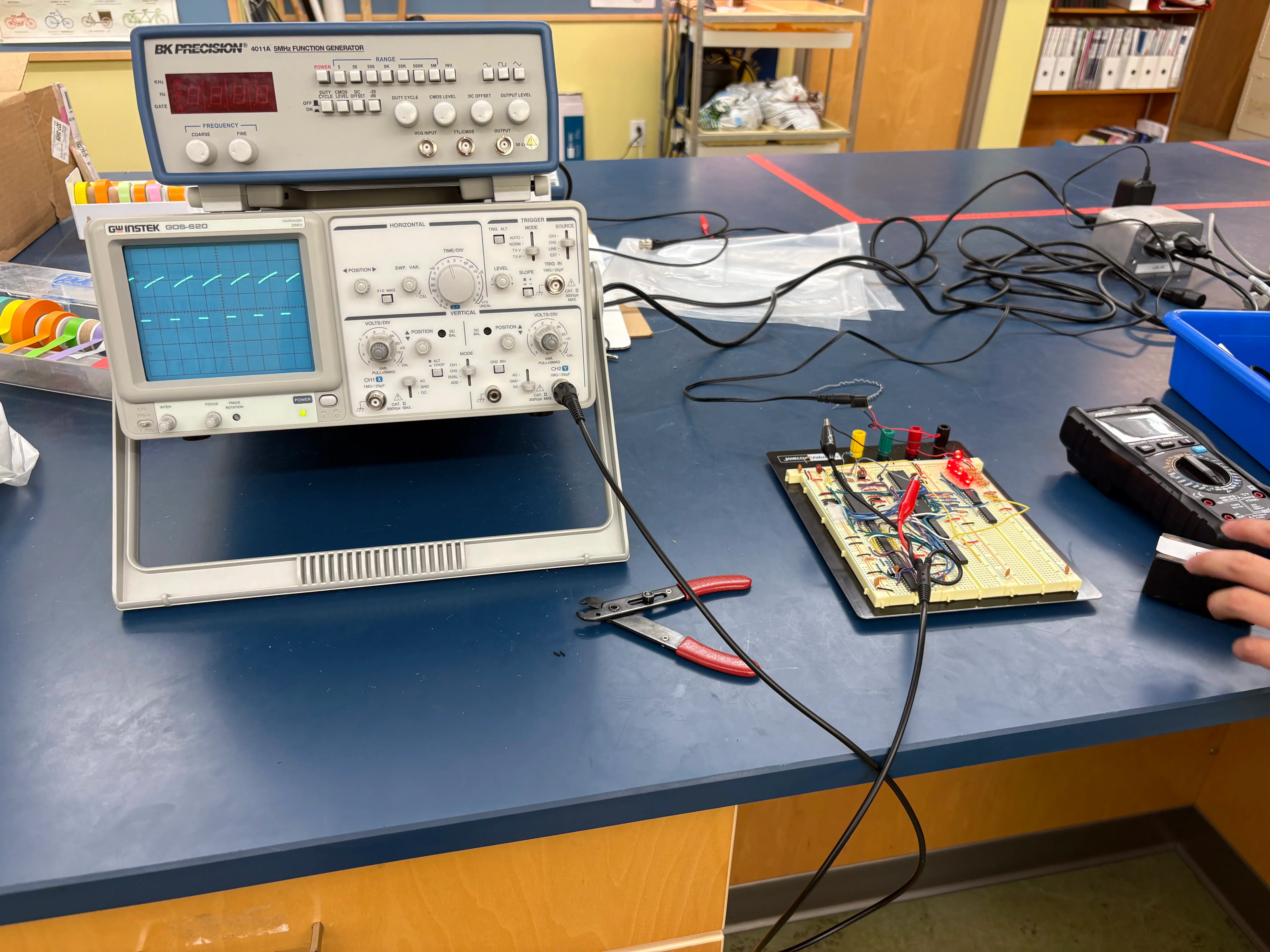
An oscilloscope trace of the 555 timer on the board.
Scuffed Emulator
This emulator simulates a program on the computer and finds the period of the execution (since we only have a few bits of state). I wonder if we can find a busy beaver for this thing…
def nez(x, bit):
    return 1 if x & (1<<bit) != 0 else 0

def bin4(x):
    return bin(x | 4096)[-4:]

def hex4(x, n=2):
    return hex(x | 4096)[-n:]

class Instruction:
    def __init__(self, name, op, control):
        self.name = name
        self.op = op
        self.control = control

        self.alu = control >> 4
        self.m = nez(control, 3)
        self.cn = nez(control, 4)
        self.acc = nez(control, 2)
        self.rw = nez(control, 1)
        self.pc = nez(control, 0)

        globals()[str(self)] = self

    def __str__(self):
        return self.name[0]

    def info(self):
        return f"{hex4(self.op)} op[{bin4(self.op)}] -> " + \
            f"{hex4(self.control)} sel={nez(self.op, 0)} " + \
            f"alu[{bin4(self.alu)},m={self.m},cn={self.cn}] " + \
            f"acc={self.acc} rw={self.rw} pc={self.pc}"

    def __call__(self, *const):
        if len(const) > 0 and not nez(self.op, 0) == 0:
            # print("warn: only immediate-type instructions take args")
            pass
        return AsmLine(self, const[0] if len(const) > 0 else 0)

class AsmLine:
    def __init__(self, instr, const):
        self.instr = instr
        self.const = const

    def __str__(self):
        if self.instr.name[0].endswith('i'):
            return f"{hex4(self.instr.op << 4 | self.const)} | {bin4(self.instr.op)}" + \
                f" {bin4(self.const)}\t{self.instr} {self.const}"
        return f"{hex4(self.instr.op << 4)} | " + \
            f"{bin4(self.instr.op)} 0000\t{self.instr} *addr"

    def pseudocode(self):
        return self.instr.name[1] % \
            (self.const if self.instr.name[0].endswith('i') else '*addr')

control = [0xAA, 0x92, 0x62, 0xFC, 0xFE, 0xCF, 0x0F]
names = [("load", 'a = (addr:=%s)'),
    ("add", 'a += (addr:=%s)'),
    ("sub", 'a -= (addr:=%s)'),
    ("store", '*(addr:=%s) = a'),
    ("read", 'addr = %s'),
    ("jmp", 'pc = (addr:=%s)'),
    ("jez", 'pc=(addr:=%s) if a == 0')]

alus = {0b1010_10: lambda a,b: b, 0b1001_01: lambda a,b: a+b,
    0b0110_00: lambda a,b: a-b, 0b1111_11: lambda a,b: a,
    0b1100_10: lambda a,b: 0b1111, 0b0000_10: lambda a,b: ~a}

instructions = []
opcode = 0
for ctl, name in zip(control, names):
    instructions.append(Instruction((name[0]+'i', name[1]), opcode, ctl))
    instructions.append(Instruction(name, opcode+1, ctl))
    opcode += 2

for i in instructions:
    # print(f"{str(i)} {i.name[1]%'ARG'}")
    print('\t', i.info())


class Chump:
    def __init__(self, prog, pc=0, acc=0, addr=0):
        self.pc = pc
        self.acc = acc
        self.addr = addr

        self.prog = prog
        self.ram = [0 for i in range(16)]
        self.ticks = 0
        self.states = dict()

    def clock(self):
        state = (self.pc, self.acc, self.addr, tuple(self.ram))
        if state in self.states:
            print(f"Repeated after {self.ticks} (previously on tick {self.states[state]})")
            return False
        self.states[state] = self.ticks

        cur = self.prog[self.pc]

        greenpre = self.ram[self.addr] if cur.instr.op & 1 else cur.const

        idx = cur.instr.alu << 2 | cur.instr.m<<1 | cur.instr.cn
        alu = alus[cur.instr.alu << 2 | cur.instr.m << 1 | \
                cur.instr.cn](self.acc, greenpre) & 0b1111
        if cur.instr.acc == 0:
            self.acc = alu
        self.addr = greenpre
        if cur.instr.rw == 0:
            self.ram[self.addr] = self.acc
        if cur.instr.pc and alu == 0b1111:
            self.pc = greenpre
        else:
            self.pc += 1
        print(f'{self.ticks:<5}\t{bin4(self.acc)} {self.acc:<2} " + \
              f"pc={self.pc:<6} after {cur.pseudocode()}')
        self.ticks += 1
        return True
        # print(self.ram, self.addr)

def prog2bin(prog):
    return [i.instr.op << 4 | i.const for i in prog]

def bin2prog(bin):
    return [instructions[i >> 4](i & 0b1111) for i in bin]

nop = loadi(0)

progtest = [
    loadi(1),
    storei(0), # A [N]
    storei(1), # B [N-1]

    readi(0),
    load(),
    readi(1),
    add(),
    storei(1), # 1 is now A+B [N+1]

    readi(0),
    add(),
    storei(0), # 0 is now A+(A+B) [N+2]

    jmpi(3)
]


print('\n\nno.mem\tv  | 4321 4321')
for idx, i in enumerate(progtest):
    print(f"{str(idx + 100000)[-2:]}.{hex4(idx)}\t{str(i):<32} {i.pseudocode():<20}")

print()

chump = Chump(bin2prog([0x01, 0x60, 0x61, 0x80, 0x10, 0x81, 0x30,
        0x62, 0x80, 0x10, 0x61, 0x82, 0x10, 0x60, 0xa3]))

while chump.clock():
    pass