| |||||||||||||||||||||||||||||||
|
Renaissance re-enactment
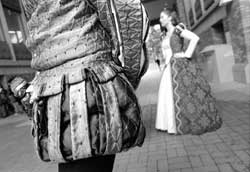
Wearing a red and yellow vest over a white cotton ruffle dress shirt, dark dress pants, worn, brown knee-high boots, a hat made from velvety fabric and a long silk-lined cape, Tovio Raiven indulges in his childhood hobby. In eighth grade, Raiven, a Seattle resident, happened across an article about the Society for Creative Anachronism (SCA), an organization dedicated to researching and re-creating the lifestyles of pre-17th-century Europe. The organization, which has a UW chapter, inspired Raiven to pursue the re-enactment of day-to-day life from the Renaissance and the Middle Ages. While Raiven now re-enacts with the Seattle chapter of the SCA, the UW chapter is very active. The SCA chapter at the UW is called the College of St. Bunstable. The student-run group has been on campus for more than 10 years and has a membership of 15 people, including undergraduate and graduate students; as well as alumni and faculty. It is funded by the greater Seattle SCA branch, called the Barony of Madrone. The society exists mainly for the enjoyment of the members who enjoy each other's company while participating in 15th- to 17th-century hobbies. "For the most part we are a pretty self-contained group and do not go out and 'perform' for the general public," said Jennifer Eastberg, the chatelaine, or public relations officer, of the University chapter of SCA. Eastberg said the group is open to anyone affiliated with the UW, and the campus community is encouraged to look into the group if interested. The College of St. Bunstable usually holds two events a year near campus. These events feature food, arts demonstrations, dancing, fighting demonstrations and historical games. However, most of the members' time is spent researching historical time periods or lifestyles. Many group members get into the spirit of the Renaissance by researching names that match their personalities.
However, the SCA is different than most Renaissance re-enactment organizations because it is not allowed to stage historic moments, just re-create scenes from the general era. This means actors do take on personalities of historical figures such as King Henry VIII. "Many people develop a whole persona -- name, residence, age (and sometimes birthday), occupation and life stories," Eastberg said. Group members hold regular meetings and activity nights that are held in modern dress and usually last a few of hours. It is typical to find members participating in crafts, learning an ancient dance or mastering a song from the specific time period they are interested in. Events hosted by the UW SCA require an attempt at the re-creation of pre-17th-century dress. These events take anywhere from one evening to a week to prepare for. The group gets together to make clothes while others buy or rent outfits that fit the time period of the event. Raiven's mother taught him to sew when he was younger, which opened the door to his hobby, and now Raiven spends hours sewing costumes for the group. Elsewhere in Seattle, another Renaissance group called the Society of Saint Margaret Guild portrays the court of Queen Mary of Scotland, who is also know as Mary, Queen of Scots. Like the UW SCA chapter, guild members choose a character they wish to be and act and dress like them. Meghan Marion, a student at Pacific Lutheran University in Parkland, Wash., re-enacts the life of Mary Fleming, a lady in waiting for Queen Mary. She explained she does historical research to give her a better idea of who her character was, including personality and reputation. Chris Forest, another guild member and Seattle resident, does not choose to dress as a particular character, but rather has pieced together an outfit that has a strong focus on a codpiece. Forest wears tights reaching up to his thighs and a gold and maroon suit that reaches from the neck to the thigh. He also wears a codpiece, an ornamental article used for men to keep their genitals separated from the rest of their body. The codpiece, which was originally filled with mercury to treat syphilis, eventually developed into a decorative item of clothing. Forest explained that guild members can be peasants, pirates, gypsies and belly dancers; all societal positions from the renaissance are available for re-enactment. The catch is that actors must abide by the class rules that guided the life of a person with the character's stature through life. Most women in the Saint Margaret Guild wear heavy, layered dresses with detailed embroidery and lining. Marion explained that, in the summer during the many festivals the group attends in costume, the dresses become so hot that the women must rock back and forth to circulate air under the dress. For Marion, the most enjoyable part about being involved with a Renaissance group is learning the history. She is slowly learning dances, and her favorite is a brawl called Toss the Duchess. A brawl is a simple country-dance that portrays the everyday moments of life, such as a wife arguing with her husband about who will do the laundry. Members of upper-class Renaissance society participated in complicated dances that derived from an Italian style, according to Raiven. Just as music has a large impact on today's culture, it impacted the Renaissance. Many re-enactors sing carols from the time period or play instruments that originated during the era. Raiven plays the lute, a string instrument from the time, as well as a recorder, a type of wind instrument. In addition to singing and dancing, the greater Seattle group works on pewter casting, rapier and sword-and-shield-style fighting, blacksmithing, recipe reconstruction, equestrian skills, weaving, singing, drama, more in-depth costuming and scribal arts. And, according to Renaissance tradition, all gentlemen must know how to use a sword in order to defend himself. Since group members attempt to re-create the Renaissance lifestyle with the utmost accuracy, many learn this skill. "Even though I have been doing this for a long time I am still not entirely confident," Ravien said. "You can practice but still mess up." Raiven explained that some members even choose to live as if they are actually in medieval times. They make their own fabric, raise or hunt their food and make all of their own clothes. Many people brew their own beer and roll their own tobacco. "Modern culture rushes everywhere and doesn't enjoy things such as cooking and sewing," Raiven said. During the Renaissance, feasts and celebrations were common, and for the members of the Seattle SCA chapter, life is no different. The Yield Feast, which the group hosts annually on Dec. 18, is a holiday celebration in which re-enactors come together to enjoy the traditions of the period. There is a magic show, music, dancing and an extensive menu. The cooks spend days preparing the meal, which this year included sausage shaped like a hedgehog with chestnuts intended to imitate how the animal looked when served. Mincemeat pie, where the meat had been marinated for months and is used in the crust, was prepared, and there was also a boar's head where the animal's brains were served as a delicacy. Ravenrook, a Seattle-based organization that cooks, practices country dancing and sword fighting, helped make the SCA event possible. Like everything else, the menu attempted to replicate medieval times. "If you are interested in history you become infatuated with this because you keep learning more, and you also learn to be more outgoing," Marion said. |
| |||||||||||||||||||||||||||||